

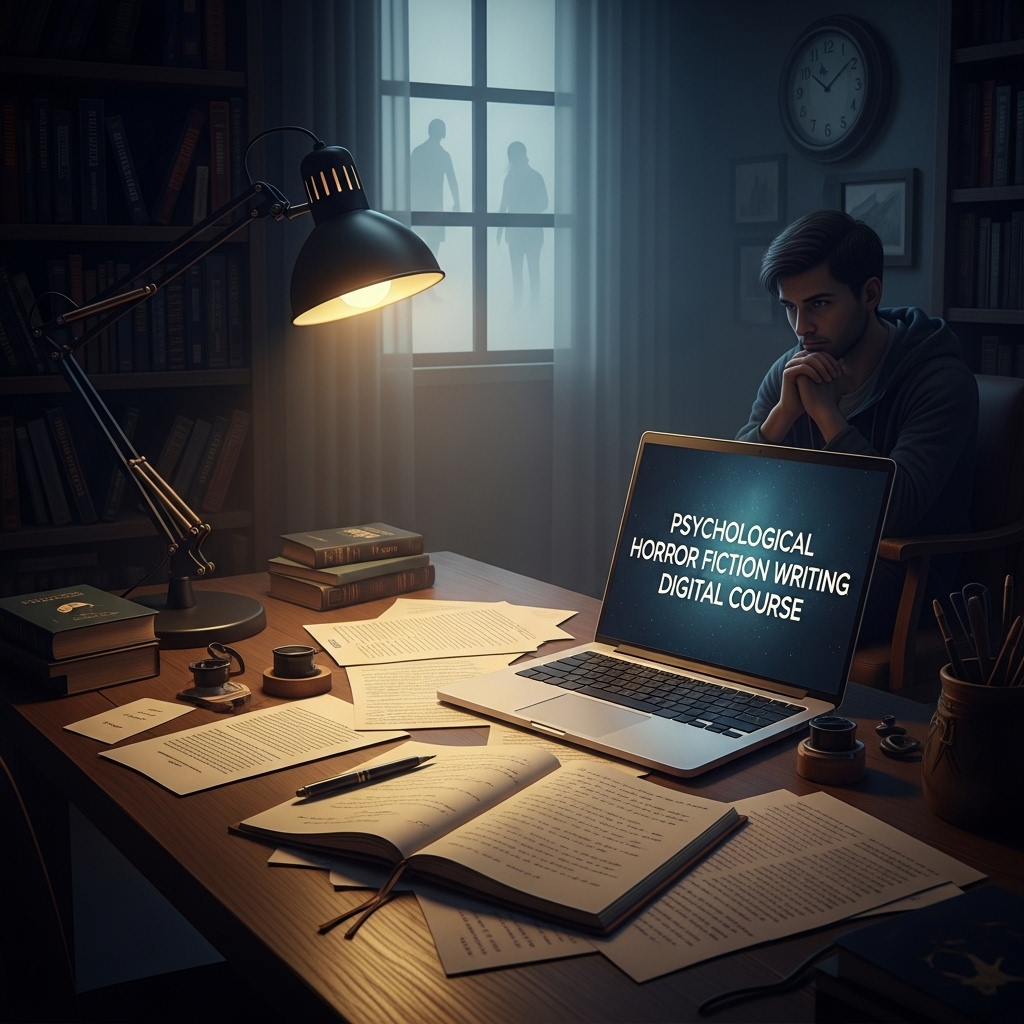
Psychological Horror Fiction Writing Digital Course
🕯️ The Scariest Stories Are Never About the Monster. They’re About the Mind That Can’t Escape It.
There is a reason the horror fiction that lodges deepest in the psyche is almost never the kind that relies on what you can see. The creature with the too-many-teeth emerging from the dark, the masked figure with the kitchen knife, the jump scare in the hallway: these things startle. They spike adrenaline, they disrupt comfort, and they are forgotten inside a week. But the horror story that lingers for years, the one that resurfaces when you wake at 3am and the room is a little too quiet, the one you find yourself thinking about while doing something ordinary and entirely mundane, is built on something different. It lives not in the monster’s face but in the protagonist’s unraveling mind. In the thought they cannot unthink. In the slowly dawning realization that the most dangerous place in the story was always the inside of their own skull.
Psychological horror is the deepest, most demanding, and most enduring subgenre in all of dark fiction. It is the space where horror and literary fiction converge, where the architecture of the human psyche becomes the terrain, and where the writer’s true craft is exposed with nowhere to hide. A well-placed creature can cover many sins. Psychological horror cannot. If the reader doesn’t feel the protagonist’s interiority, if the dread doesn’t accumulate the way genuine psychological unraveling does, if the truth of what the character is experiencing doesn’t carry its own horrible logic, the story fails. The monsters are easy. The mind is hard.
The Psychological Horror Fiction Writing Digital Course is a comprehensive, deeply developed digital learning system for writers at every level who want to master the craft of psychological horror. This is not a genre primer. It is a complete creative and technical education in the specific narrative mechanisms, character construction methods, atmospheric techniques, structural frameworks, and prose strategies that make psychological horror work at the level of the best in the genre, from Shirley Jackson’s epistolary dread to Thomas Tryon’s suburban unraveling to Carmen Maria Machado’s body-horror surrealism to Paul Tremblay’s modern ambiguity.
The course is built around one central craft premise: psychological horror is, at its foundation, a problem of epistemology. The reader must never be entirely certain what is real. The character must never be entirely certain either. And the writer must hold that uncertainty together with perfect, deliberate precision so that it creates dread rather than confusion. That is the balance this course teaches.
📦 Everything Included in This Digital Course
This is a 100% digital product. Nothing ships physically. Your instant download contains:
Core Course Curriculum (.pdf, 11 modules, 260+ pages of craft instruction)
Module 1: The Psychology of Fear, Dread, and Unease (22 pages) Before writing psychological horror, a writer must understand the mechanisms of psychological fear from the inside out. This module covers: the distinction between fear (acute, object-directed), dread (diffuse, anticipatory, often object-less), unease (the persistent low-grade wrongness that psychological horror produces at its best), and how each functions differently in the reader’s nervous system. It covers the cognitive science of the uncanny, the neuroscience of anticipatory anxiety, the role of pattern-recognition disruption in producing horror, and how great psychological horror writers have intuitively or deliberately exploited these mechanisms. This is the theoretical foundation that makes every subsequent craft lesson land with full explanatory power.
Module 2: The Unreliable Narrator as the Central Horror Instrument (24 pages) A comprehensive treatment of unreliable narration in psychological horror. Covers the full spectrum of narrative unreliability: the narrator who lies (deliberately concealing truth from the reader), the narrator who is deceived (sincerely believing something that isn’t true), the narrator who is fractured (whose perception and memory are themselves the source of horror), and the narrator who may be correct but presents reality in ways that destabilize the reader’s certainty. In-depth analysis of how Shirley Jackson deploys unreliable interiority in “The Haunting of Hill House,” how Thomas Harris uses Clarice’s perception to manage the reader’s experience of Hannibal Lecter, and how Kelly Link’s surrealist approach to unreliability creates a distinctive flavor of dread. Includes a taxonomy of 12 unreliable narrator types with craft examples for each.
Module 3: Building Psychological Character in Horror (26 pages) The psychology of the horror protagonist in depth. Covers: trauma as backstory vs. trauma as present-tense psychological state (the most common mistake newer horror writers make is treating character trauma as explanation rather than as active force), the architecture of a character whose psychology makes them specifically vulnerable to the horror they encounter (not generic vulnerability but fitted, specific, inevitable vulnerability), the difference between a character whose mental illness is portrayed with accuracy and humanity vs. one that treats mental illness as convenient horror shorthand, building characters whose perceptions the reader inhabits so completely that the reader cannot fully distinguish character reality from character distortion, and the specific craft of the horror character’s interiority in close third and first person.
Module 4: The Slow Burn: Pacing and Dread Architecture (22 pages) Structural approaches to building and sustaining dread over the length of a story. Covers: the dread ramp (how to begin a story at minimal unease and escalate toward horror without tipping into farce or numbing the reader), the pause and acceleration rhythm of psychological horror (moments of false safety that allow reader re-engagement before the next escalation), scene-level dread construction, the function of normalcy in a horror narrative (the ordinary world must be rendered with enough solidity to make its corruption feel like genuine loss), and the structural analysis of pacing in selected psychological horror novels including “Mexican Gothic” by Silvia Moreno-Garcia, “The Silent Patient” by Alex Michaelides, and “Hex” by Thomas Olde Heuvelt.
Module 5: Atmosphere as a Narrative Force (22 pages) How psychological horror uses environment not as backdrop but as active participant in the psychological unraveling of the characters. Covers: pathetic fallacy deployed with precision vs. pathetic fallacy deployed with clumsiness (the difference between atmosphere that creates dread and atmosphere that signals dread heavy-handedly), sensory detail selection in horror (which sensory details trigger dread responses and which register as merely descriptive), the architecture of the horror house, hotel, hospital, and town as psychological spaces, the specific craft of imbuing familiar spaces with wrongness, and the underused power of mundane settings (psychological horror set in well-lit, ordinary places often achieves greater unease than gothic mansions because it removes the reader’s psychological preparation for fear).
Module 6: The Monster Inside: Psychological Horror Without a Supernatural Element (20 pages) Psychological horror rooted entirely in human psychology and behavior. Covers: the specific craft challenges of horror that must create dread through character alone, the predator-as-horror figure and how to write antagonists whose humanity is more frightening than their monstrousness, domestic horror and the horror of the ordinary turned oppressive, the unreliable reality of mental illness narratives that neither stigmatize nor exploit, and the particular power of horror that the reader cannot dismiss because it has no supernatural element to use as psychological distance.
Module 7: Prose Style in Psychological Horror (20 pages) The sentence-level craft of horror writing. Covers: sentence rhythm and its relationship to dread (shorter sentences during horror sequences is not always correct, longer, enveloping, subordinate-clause-dense sentences can create their own particular claustrophobia), word selection in horror (the specific vocabulary of dread vs. the vocabulary of fear vs. the vocabulary of disgust), the craft of the detail that haunts (what makes one specific detail linger in a reader’s memory for years while another detail of equal narrative importance is forgotten immediately), point-of-view management in close horror (how tightly to inhabit a character’s consciousness and when to pull back slightly for effect), and the analysis of paragraph and scene construction in passages from Shirley Jackson, Joyce Carol Oates, Carmen Maria Machado, and Paul Tremblay.
Module 8: Ambiguity as a Craft Tool (18 pages) The deliberate maintenance of interpretive openness as a horror strategy. Covers: the difference between productive ambiguity (which deepens the reader’s engagement and compounds dread on reflection) and ambiguity as a failure of commitment (which leaves readers feeling cheated or confused), how to construct an ending that is genuinely ambiguous rather than merely unresolved, the double-reading architecture where a horror story supports both a supernatural and a psychological interpretation with equal narrative validity, and in-depth analysis of ambiguity in Henry James’s “The Turn of the Screw,” Shirley Jackson’s “We Have Always Lived in the Castle,” and Paul Tremblay’s “A Head Full of Ghosts.”
Module 9: Subgenre Craft: Hauntings, Body Horror, Gaslighting, Paranoia, and Trauma Horror (24 pages) Dedicated craft instruction for the five most significant subgenres within psychological horror. For each: the specific narrative mechanics that define it, the specific craft challenges it presents, the specific pitfalls that undermine it, and worked craft examples from the genre’s strongest practitioners.
Module 10: Structure and Form in Psychological Horror (20 pages) How structural choices contribute to psychological effect. Covers: the epistolary horror format and its specific dread advantages (documents, found footage, journals, transcripts as both content and form), the fragmented structure as psychological mirror, non-linear chronology and how it creates dread through dramatic irony (the reader knowing what is coming before the character does), the novella as the ideal length for psychological horror and why, and the craft of the frame narrative in horror.
Module 11: Revision, Submission, and Publishing for Horror Writers (22 pages) The professional craft dimension. Covers: revision strategies specific to psychological horror (what to look for in revision that is unique to the genre, including the dread-consistency audit and the certainty-level check), the horror short fiction market (the magazines, anthologies, and publishers that define the genre, submission strategies, and what editors of horror fiction specifically look for in psychological horror submissions), the horror novel market including small presses, Big Five imprints, and independent publishing, and the specific craft of the horror synopsis and query letter.
Craft Workshop Workbook (.pdf + editable .docx, 75 structured writing exercises) Seventy-five exercises designed to develop specific psychological horror craft skills, organized by module and difficulty level. Every exercise includes: a specific craft objective, the prompt, an example of the exercise completed at a strong level, and a self-assessment guide. Exercises include: writing the same scene from three levels of narrative reliability, writing horror using only sensory details from a single sense, the escalating dread exercise (beginning a scene at emotional neutral and reaching full horror over 500 words without a single overtly scary image), the uncanny ordinary exercise (describing a perfectly normal room until it becomes unbearable), the unreliable memory exercise, and the ambiguous ending exercise.
Annotated Reading Guide (.pdf, 28 pages) A curated reading guide to 40 essential psychological horror texts (novels, novellas, and short story collections) with craft-focused annotations for each, explaining not just what the work is but what specific craft techniques it demonstrates, what module content it illuminates, and what a writer should pay particular attention to when reading it for craft development. Organized into tracks by psychological horror subgenre and by craft skill being studied.
Plot and Story Structure Templates for Psychological Horror (.docx, 6 frameworks) Six structural templates specifically designed for psychological horror, including: the unreliable unraveling structure (for stories of psychological deterioration), the haunted past structure (for trauma horror with dual timelines), the paranoia escalation structure, the gaslighting structure, the found document frame structure, and the ambiguous ending structure. Each template provides: the structural beats, the pacing guidance for each beat, the character arc alignment, and the reader experience being created at each stage.
✅ What This Course Does That No Other Writing Resource Does
Interiority as the Primary Subject: This course treats the character’s psychological interior not as a detail of characterization but as the primary setting and source of horror. Most writing courses treat psychology as character backstory. This course teaches it as active narrative terrain.
Fear Science Applied to Craft: The module on the psychology of fear translates cognitive science into directly applicable craft decisions, giving writers the specific knowledge of why certain choices create dread and others don’t, rather than only the tradition of horror writing as proof of what works.
The Ambiguity Module: Very few craft resources treat narrative ambiguity as a deliberate, learnable skill. This course dedicates 18 pages to the craft of productive ambiguity, which is perhaps the single most characteristic technique in the best psychological horror.
🎯 Written For
- Fiction writers who have read widely in horror and want to understand at a craft level why their favorite works create the effects they do
- Writers from other genres transitioning into psychological horror or dark literary fiction
- Short story writers targeting the horror magazine and anthology market
- Novelists developing their first horror project who want structural foundations before drafting
- Experienced horror writers who want to deepen their craft toolkit in the psychological subgenre specifically
🗃️ What Haunts Your Download Folder
📕  Core Curriculum — 11 modules, 260+ pages of craft instruction (.pdf)
📝  Craft Workshop Workbook — 75 structured horror writing exercises (.pdf + .docx)
📚  Annotated Reading Guide — 40 essential texts with craft annotations (.pdf)
🗂️  Story Structure Templates — 6 psychological horror plot frameworks (.docx)
Reviews
There are no reviews yet.